Overview
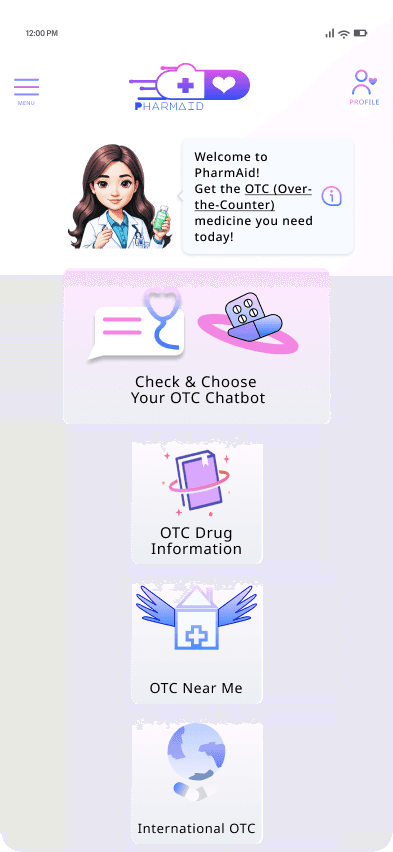
PharmAid
Helping you make safe, informed OTC decisions—anytime, anywhere.
8 Minute Read
Solo UX Designer
Project Length: 100-Hr
Defining the Problem
Context, Problem & Goals
Context
A lot more people are choosing OTC (Over-the-Counter) drugs globally instead of visiting doctors. OTC revenue in USA grew from 23 Billion in 2011 to 43B in 2023 Global OTC drug sales projection. (Statista, 2025)
Problem
⚠️
However, many lack the knowledge to confidently choose the correct medication or receive immediate guidance when needed.
Goals
💡
A chatbot that guides users from simple symptom checking to appropriate OTC drug recommendations
Access clear information on dosage, usage, and side effects
Data Gathering
Research Methodology
🎤
1
Research Interviews
5 Interviewees
4 live in the United States, 1 lives in London
📝
2
Surveys
OTC usage behaviors, decision time making
📚
3
Secondary Research
Read Essays
Did competitive analysis
Primary Persona
General Public

Needs and Painpoints
✅ Needs quick, jargon-free recommendations for OTC medications.
❌ Feels overwhelmed by the number of options for the same symptoms.
⏳ Avoids asking pharmacists for help due to long wait times.
📱 Unaware that pharmacy apps offer stock tracking and aisle locators
For example, with constipation, there are so many options, fiber supplements, enemas, laxatives, so knowing which one is best for my case can be tricky.
Secondary Persona
World Traveler

Needs and Painpoints
🚫 Unfamiliar drug names abroad require Extra Research.
🌍 Language Barriers make it difficult to verify ingredients or ask questions.
💊 Uncertainty about OTC drug Availability in certain Regions.
In Kenya, I also brought my own because I wasn’t sure if I could get the right OTC drugs.”
Competitive Analysis
Market Opportunity: Symptom Checkers Exist, But OTC Recommendations Don't
I conducted a competitive analysis by comparing PharmAid with ADA, a direct competitor, alongside the most aligned features from indirect competitors and one secondary competitor. This helped identify market gaps and informed feature prioritization and design decisions.
Categories
Direct
Competitor
Indirect Competitor
Secondary
Competitor
Brands
PharmAid
Our Solution
ADA

Mayo Clinic
GoodRx
OTC Recommendation
✅
❌
International Drug Equivalence/ Other Travel Functions
✅
❌
🚀
Our Competitive Edge
We're the only platform that provides OTC Recommendation per symptoms & allow Travellers to check international drug equivalence Instantly.
Ideating per Key Insights
3 Key Insights & Corresponding Design Response
I summarized 3 key insights about difficulties and desires in purchasing OTC drug.
1
Efficiency is Key
Users are overwhelmed and make uninformed decisions.
67% feel overwhelmed by options
Most don't check interactions
Rely on brand names, not facts
“AI could fill that gap when doctors aren’t accessible.”
Interviewee 3
2
Overwhelming Choices, Little Accessibility to Guidance
Barriers prevent confident medication decisions abroad
Language barriers limit ingredient verification
Unknown drug availability creates anxiety
User education lags market growth
“In Kenya, I also bring my own because I’m unsure if I can get the right medication there.”
Interviewee 4
3
Pharmacy Access With Split Preferences
Users can't check medication stock before visiting, resulting in multiple pharmacy trips. Finding medicines in-store is frustrating, especially when sick.
Preferences split: some want stock visibility for planned pickup, while
others prefer delivery to avoid going out when unwell.
Design implication: Dual solution needed
🏪 In-Store Shoppers
Users lack the channel to check if a pharmacy carries the drug before visiting.
Interviewee 3
📦 Delivery Seekers
It will be helpful if medicine can be delivered to the door. Sometimes we are too sick to get out from the bed.
Interviewee 1
Bridging the Define & Ideate Stage
How Might We (HMW)…
HMW
How might we leverage pharmacists' expertise to help customers better understand OTC drug usage and consider their health conditions, even when pharmacists are unavailable?
⬇️
EFFICIENCY IS KEY
HMW
How might we streamline the process of checking OTC drug equivalents, travel restrictions, and availability for global travelers?
⬇️
ACCESSIBILITY IS KEY
Solution Evolution
From 5-Feature Architecture to 4-Feature + Renamed
Initial design:
5 separate features
Solution:
Consolidated 3 features into one conversational chatbot
Symptom Diagnosis + OTC Recommendations + Interaction Checker
Matched users' mental models of AI interfaces
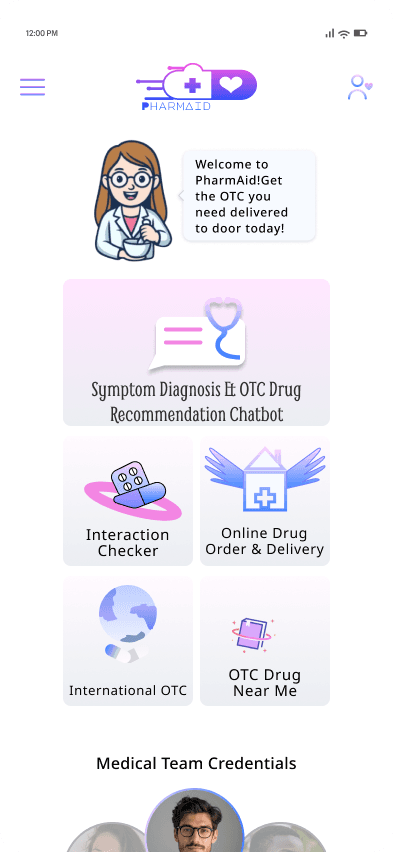
Initial design:
Solution:
Testing Results
Round 1 testing revealed feature confusion and navigation gaps
Drug Interaction Checker
62.5 %
Feature Confusion
International OTC Drugs
42.9 %
Navigation gaps
OTC Near Me
0 %
Navigation gaps
Cross-Border Regulations
14.3 %
Navigation gaps
Solution 1: Feature 1
Drug Interaction Checker Design + Iterations
🧪
I ran 2 rounds of usability testings:
1st round: low-fi wireframes;
2nd round: high-fi prototype testing
After 1st round of testing, the Interaction Checker was combined into the Symptom Diagnosis + Drug Recommendation Chatbot. This improved clarity and made it more intuitive (with the rise of AI chatbots, it evokes similar experiences). Task completion rate changed from:
62.5%
➡️
100%
the initial design includes a Separate feature accessed by clicking from home screen
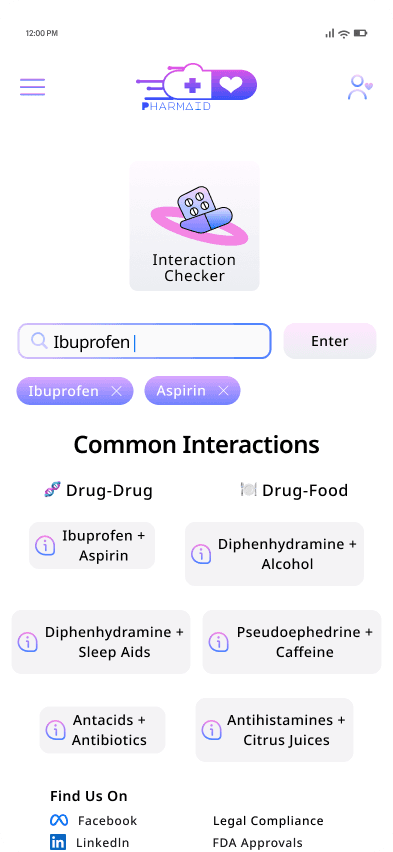
Initial design: Search Interface

final design: Integrated into chatbot
Solution: Feature 2
International OTC Lookup + Iterations
International OTC helps travelers check endemic diseases (Component 1) and find equivalent drugs across countries (Component 2). Adding intermediate steps improved success from 42.9% to 100%.
Also, users revealed the need for back navigation wayfinding. Thus, I added it to both components.
42.9%
➡️
100%
Component 1: Custom Airline & Travel Restrictions

FINAL DESIGN: added way finding
Initial Design: no return navigation
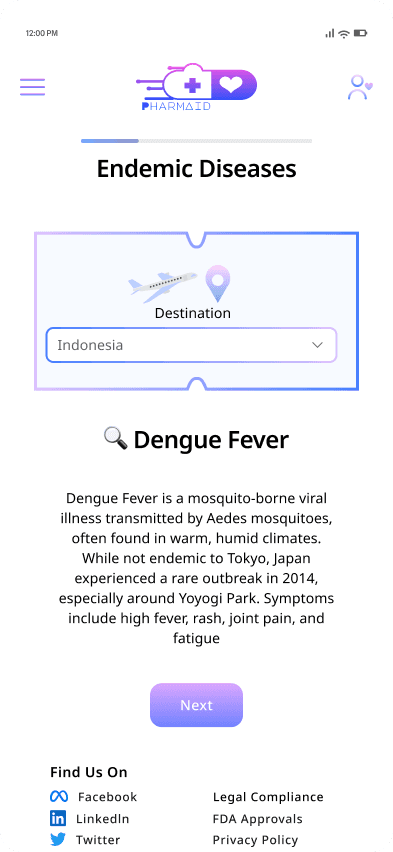
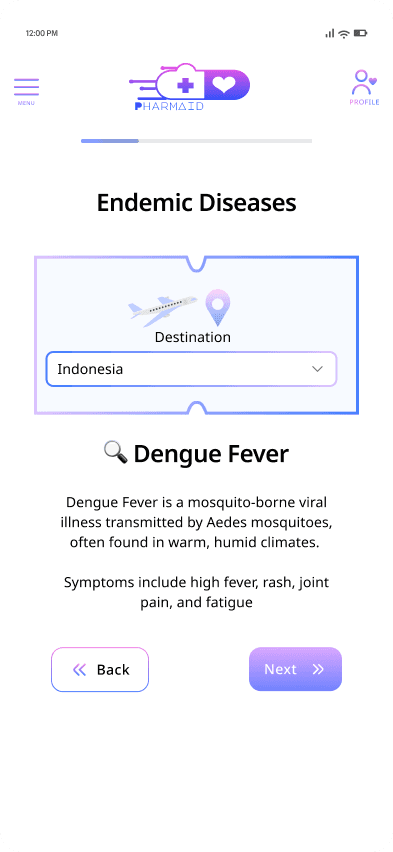
Solution: Feature 3
Solution 3: Addition of OTC Medicine Library
Round 1 Testing Revealed Users Needed A Way To Look Up Specific Medications Independently. I Added An OTC Medicine Library In Round 2, Providing Comprehensive Drug Information Including Uses, Equivalents, Dosages, And Warnings.
No such Feature: Initial design
Solution:
Consolidated OTC Drug Near Me + Online Drug Order & Delivery; but then used one menu card as OTC Drug Information.
Solution:
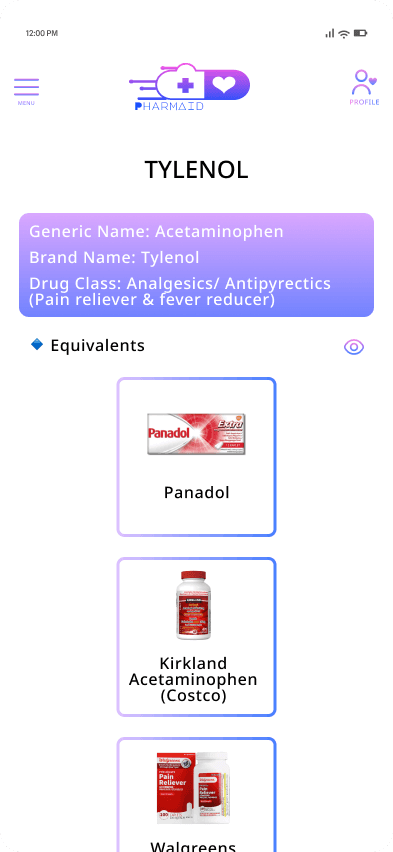
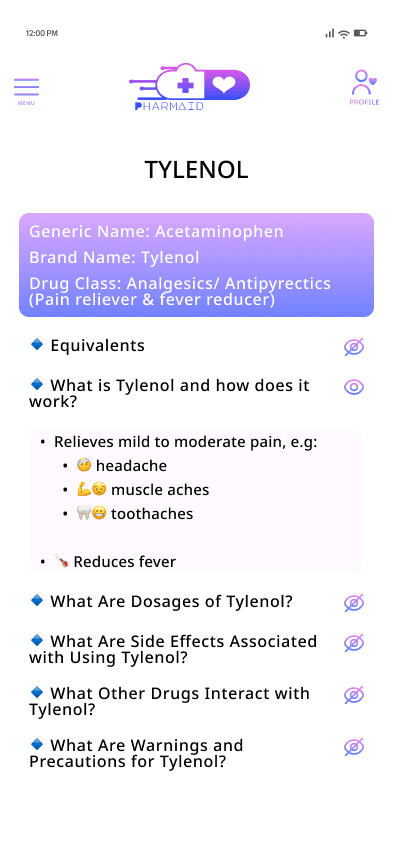
Solution: added OTC Drug Information
Low Effort but High Impact Additions
Definition Overlay + New Checkout Flow + Photo Scanning
A lot of ideas were provided by users during usability testings, some are high impact yet low effort ones, while some are required for functional prototype Testing; including adding definition of OTC drugs, Adding checkout flow for prototype testing.


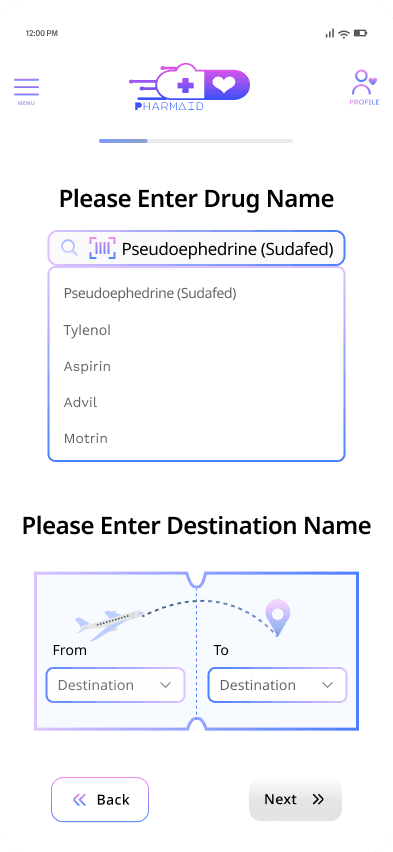
scan to search function
Key Takeaways
What I'd do differently next time
This is my first UX project, had so much fun (and some pain) in the process. YAYYYY! 🥳 I’m extremely thankful for the process, and I would like to tell my future self...
🧠
Do not overthink and just do it
I spent too much time second-guessing ideas and aiming for perfection. But design is iterative, you only move forward by doing. Progress, not perfection.
💡
always solicit feedback, digest and have confidence in your choice
Feedback is how you grow. Different perspectives push your ideas further. But learning to filter what matters most to the product, and standing by your choices, is equally important. Own your decisions and do not regret!
⏳
Every detail counts
A lot of low-fi issues arose in my 1st usability testing because of over-simplification.
This taught me that there's always a good balance between a simple yet functional Prototype.
Appendix
Explore the research, analysis, and design artifacts that informed PharmAID's
development. Each resource provides deeper insight into the strategic and creative
decisions.
Research
User Research & Insights
Analysis
Competitive Analysis
View Analysis
Brand
Brand Guide & Design System
View Brand Guide