Overview

Savings Benchmark For
Banking Apps

Savings Benchmark For Banking Apps

A plug-in feature for FDIC-insured banks

6-Minute Read

Solo UX Designer

Project Length: 100-Hr

Savings Benchmark For Banking Apps

6-Minute Read

Solo UX Designer

Project Length: 100-Hr

Context, Problems & Goals

Context, Problem & Goals

People don't know if they're saving enough, creating constant financial anxiety.

Current banking apps show balances but not "Am I on track?" Users have data but lack guidance, so they disengage entirely.

therefore, this is a feature designed to plug into FDIC insured banks, with Citibank as the example to demonstrate.

Solution

the Immediate idea of 50/30/20 rule as default + help them set up HYSA account + automating 20% to to save to HYSA per previous paycheck came up

Goals

50/30/20 benchmark – Shows savings status, allows customization

Smart spending analysis – Identifies subscription cuts to boost savings

Data Gathering

Research Methodology

I used the following data collection methods and summarized 3 personas according to their income type and money handling habits.

I used the following data collection methods and summarized 3 personas according to their income type and money handling habits.

🎤

1

Research Interviews

6 Interviewees

All lived in the United States

👣

2

Journey Mapping

Financial planning behaviors

Emotional Ups and Downs

🧪

3

Usability Testing

1st: Tested Low-Fi Wireframes

2nd: Tested Hi-Fi Wireframes

The Variable Earner

🏃 Behavior

Income fluctuates (commission, freelancing, etc.)

Avoids rigid budgeting, manages money ad hoc.

Leans on trusted friends for immediate financial advice.

Prefers clear explanations over complex tools

Medium trust in automation

High Manual Control Preference

🏃 Behavior

Income fluctuates (commission, freelancing, etc.)

Avoids rigid budgeting, manages money ad hoc.

Leans on trusted friends for immediate financial advice.

👀 Pain Points

Standard budgeting tools assume stable income, so she can't get clear financial overview

Generic advice

Financial information is lengthy and boring

Existing automation fails with income fluctuations

❤️ Needs

Income pattern detection and analysis, followed by rebalancing guidance

Dynamic budget allocation

Clean, easy to understand Visual progress tracking.

Emotional reassurance that money is being allocated safely.

FDIC-backed educational content

The Variable Earner

Prefers clear explanations over complex tools

Medium trust in automation

High Manual Control Preference

👀 Pain Points

Standard budgeting tools assume stable income, so she can't get clear financial overview

Generic advice

Financial information is lengthy and boring

Existing automation fails with income fluctuations

🏃 Behavior

Income fluctuates (commission, freelancing, etc.)

Avoids rigid budgeting, manages money ad hoc.

Leans on trusted friends for immediate financial advice.

🏃 Behavior

Income fluctuates (commission, freelancing, etc.)

Avoids rigid budgeting, manages money ad hoc.

Leans on trusted friends for immediate financial advice.

❤️ Needs

Income pattern detection and analysis, followed by rebalancing guidance

Dynamic budget allocation

Clean, easy to understand Visual progress tracking.

Emotional reassurance that money is being allocated safely.

FDIC-backed educational content

Competitive Analysis

What Competitors Are Missing

I analyzed 6 major competitors to identify market Gaps, and found the following.

1

No Smart Benchmark

All competitors require manual percentage setup- No suggested benchmark like 50/30/20

2

No variable Income Support

Assumes single paychecks and does not adapt to variable income from side hustles/ freelancing.

3

Limited Spending Analysis

Only Rocket Money suggests subscription cuts , other tracks money passively.

No Smart Benchmark

Smart Default guidance with flexibility to customize based on individual needs

Variable Income Flexibility

Percentage-based allocations adapt to fluctuating paychecks automatically

Variable Income Flexibility

Analyzes habits and suggests specific subscription cuts, provides moment of reflection for users to boost savings

1

No Smart Benchmark

All competitors require manual percentage setup- No suggested benchmark like 50/30/20

2

No variable Income Support

Assumes single paychecks and does not adapt to variable income from side hustles/ freelancing.

3

Limited Spending Analysis

Only Rocket Money suggests subscription cuts , other tracks money passively.

No Smart Benchmark

Smart Default guidance with flexibility to customize based on individual needs

Variable Income Flexibility

Percentage-based allocations adapt to fluctuating paychecks automatically

Variable Income Flexibility

Analyzes habits and suggests specific subscription cuts, provides moment of reflection for users to boost savings

Research Insight 1

1

Everyone Uses Different Methods, But No One Knows Their Baseline

I asked users about how they handle their paychecks, 6/6 users use different budgeting tools & have different workflows: apps, spreadsheets, mental math

Automation Levels Vary Widely

📝

Manual

Spreadsheets

Mental Math

⚙️

Semi-Auto

Budget Apps

Manual Checks

Automated

‘I just automate stuff’

Level of Automation

Level of Automation

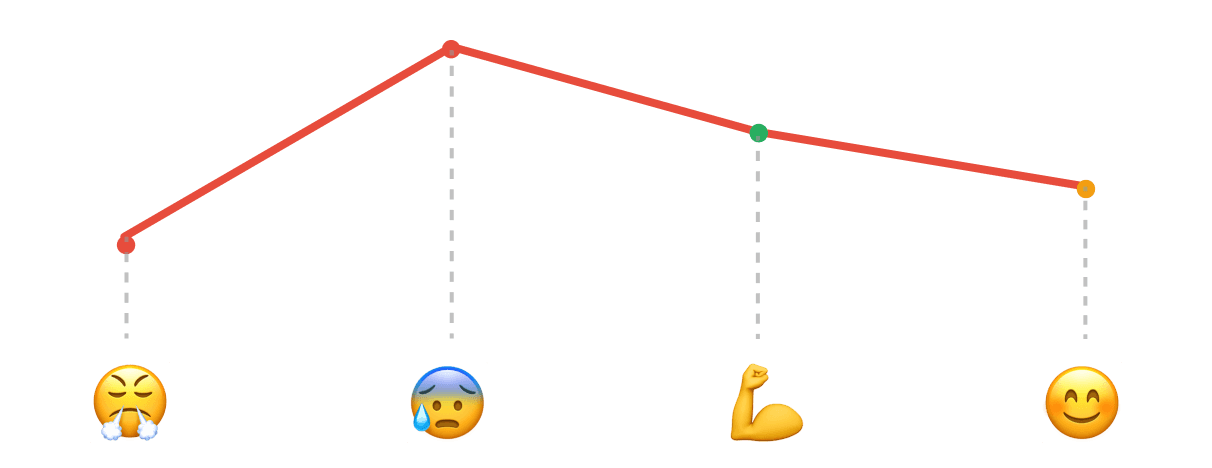
Emotional Journey: Financial Planning

📨 Receive

Stress: 70%

🔍 Review

Stress: 85%

📋 Plan

Stress: 40%

💼 Allocate

Stress: 55%

Emotional Journey: Financial Planning

📨 Receive

Stress: 70%

🔍 Review

Stress: 85%

📋 Plan

Stress: 40%

💼 Allocate

Stress: 55%

Variations:

Variations:

Smart Automator: Lower stress at Allocate

Smart Automator: Lower stress at Allocate

Variable Earner: Highest overall stress

Variable Earner: Highest overall stress

Strategic Controller: Stress at Allocate too

Strategic Controller: Stress at Allocate too

Research Insight 2

2

Flexibility > Rigid Rules

I asked whether it is helpful in distributing their paychecks per the 50/30/20 Upon Receving; while all interviewees acknowledged that 50/30/20 is a helpful foundation, however, they all also expressed the desire for flexibility.

Smart Automator

⚙️

Understands finances well

Wants Adjustable Proportions

Variabel Earner

📈

Fluctuating income

Needs flexible monthly adjustments

Strategic Controller

🕹️

Knows past bills, wants cut options

Needs quick answers, not manual spreadsheets

🔮 Future Iteration

Adjustable Proportions for users with higher level of automation

Notifications for Pause/ Resume automation from time-to-time

Priority: Establish Benchmark

Focus on providing users a clearer picture of ‘Am i Saving Enough’ question first

Provide a unified and simple starting point before advance customizations

Smart Automator

⚙️

Understands finances well

Wants Adjustable Proportions

Variabel Earner

📈

Fluctuating income

Needs flexible monthly adjustments

Strategic Controller

🕹️

Knows past bills, wants cut options

Needs quick answers, not manual spreadsheets

🔮 Future Iteration

Adjustable Proportions for users with higher level of automation

Notifications for Pause/ Resume automation from time-to-time

Priority: Establish Benchmark

Focus on providing users a clearer picture of ‘Am i Saving Enough’ question first

Provide a unified and simple starting point before advance customizations

Pivot

My Original Plan: Design HYSA Onboarding with Auto-savings

Problem: all 6 research participants have a HYSA account and I realized I was solving the wrong problem.

My Rationale behind this Idea:

Assumption:

Users need HYSA Set Up

Reality:

Users already have HYSA Set Up

When I asked about how people handle their paycheck, 1 interviewee Answered

‘I just automate stuff’

Participant 1

My follow-up questions about planning suddenly felt useless.

💡 Instead of moving on, I scheduled a deeper conversation about her emotional journey with financial planning.

Key Insight

‘Unvested money shows as cash. I don't know how much I need to save.’

‘Unvested money shows as cash. I don't know how much I need to save.’

Solution 1

1

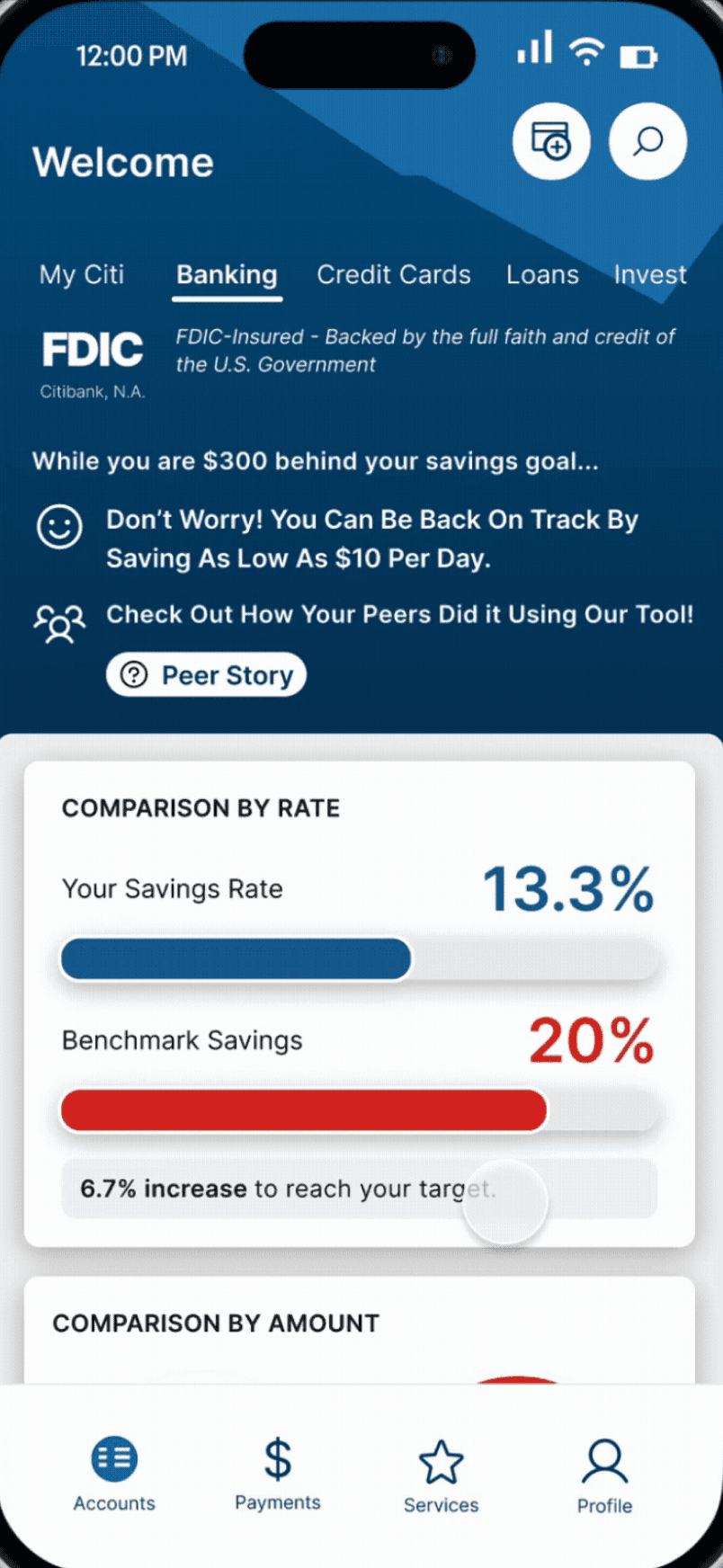
Personalized Benchmarking: Goal Tracking & Variable Income

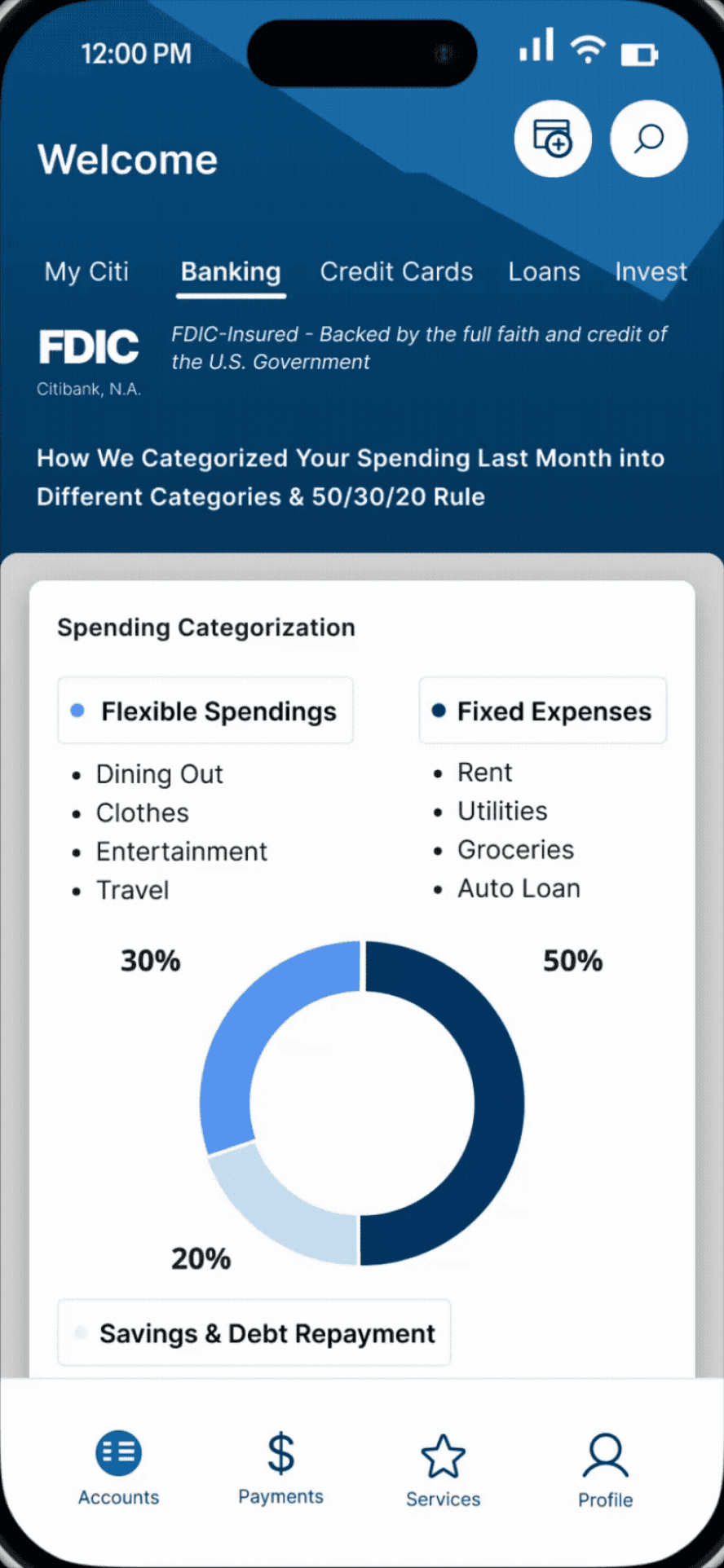
Regarding the problem of no one knows their baseline, I decided to add a Dashboard tp visualize the spending analysis with simple charts for users to be able to see things at a glance.

I also provided option to add additional income per users' comments in 1st round of usability testing.

Regarding the problem of no one knows their baseline, I decided to add a Dashboard tp visualize the spending analysis with simple charts for users to be able to see things at a glance.

I also provided option to add additional income per users' comments in 1st round of usability testing.

Spending Analysis

Spending Analysis

Benchmark Dashboard

Benchmark Dashboard

Benchmark Dashboard

Benchmark Dashboard

Impact

I feel more confident seeing the benchmark

I feel more confident seeing the benchmark

Participant

Additional Income

Additional Income

Additional Income

Impact

I feel more confident seeing the benchmark

I feel more confident seeing the benchmark

Participant

Spending Analysis

Solution 2

2

From Rigid Default

Proactive Proportion Adjustment

It took a few steps to arrive at the solution of proactive Proportion Adjustment to solve the rigidity of 50/30/20 rule problem. While users expressed the desire of flexibility in interviews, i decided not to add it as from my perspective it is sufficient by providing a benchmark to solve the problem of users not knowing how much they need to save did not want to overcomplicate mVP; and it was actually fine in 1st testing.

However, more and more voices revealed the rigidity of 50/30/20 rule, I realized this is a serious issue and made amendments.
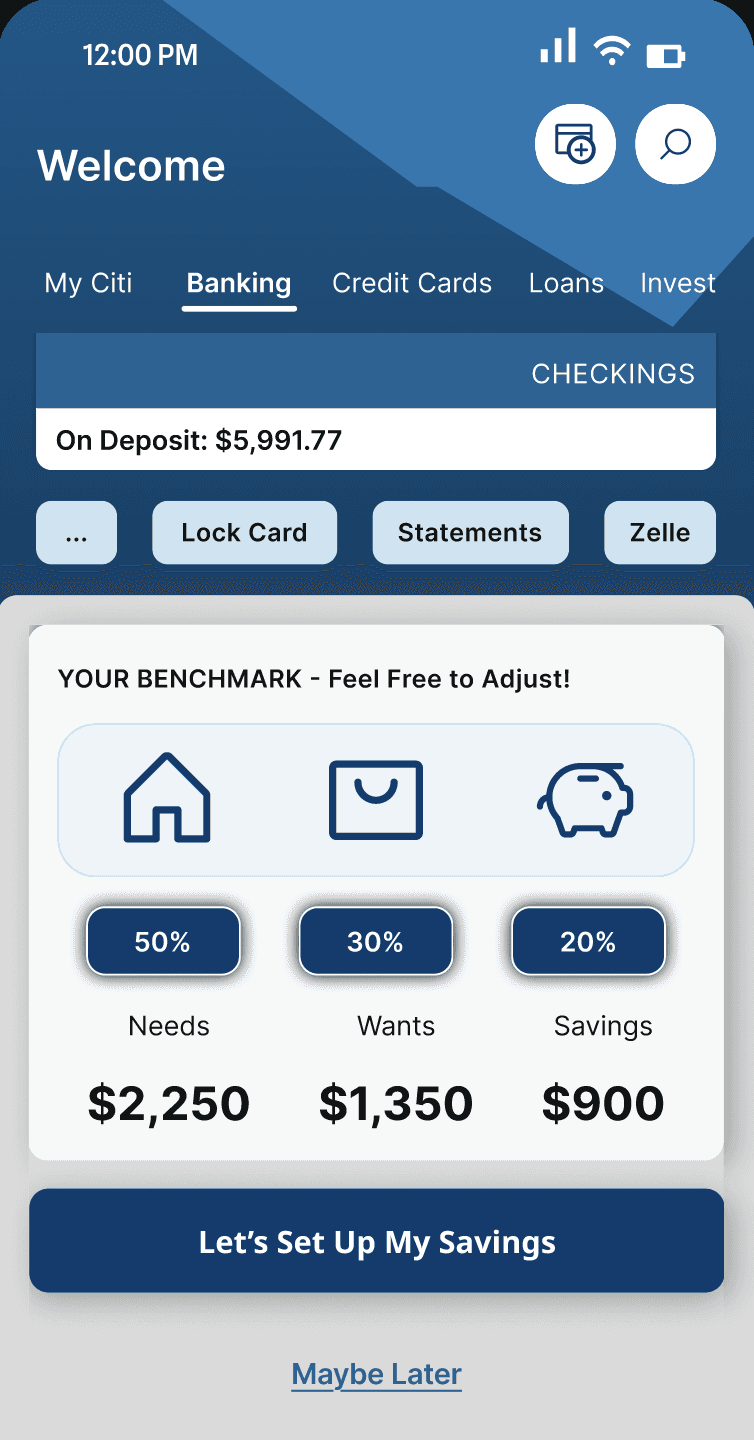
It took a few steps to arrive at the solution of proactive Proportion Adjustment to solve the rigidity of 50/30/20 rule problem. While users expressed the desire of flexibility in interviews, i decided not to add it as from my perspective it is sufficient by providing a benchmark to solve the problem of users not knowing how much they need to save did not want to overcomplicate mVP; and it was actually fine in 1st testing.

However, more and more voices revealed the rigidity of 50/30/20 rule, I realized this is a serious issue and made amendments.

2

From Rigid Default

Proactive Proportion Adjustment

Phase 1: Initial Default

Phase 1: Initial Default

Only 1/6 participants initially flagged the rigidity of the 50/30/20 rule.

Phase 2: A Little Educational Moment

Phase 2: A Little Educational Moment

Despite the prompt, further testing confirmed the default was rigid

Explicitly added the feature which provided flexibility for Variable Earners and precision for Smart Automators.

Phase 3: Final Solution (Post-Testing)

Phase 3: Final Solution (Post-Testing)

Final solution demonstrated using functional code (Figma Make) to show dynamic proportional adjustment

Solution 3

3

Actionable Guidance: Optimizing Subscriptions

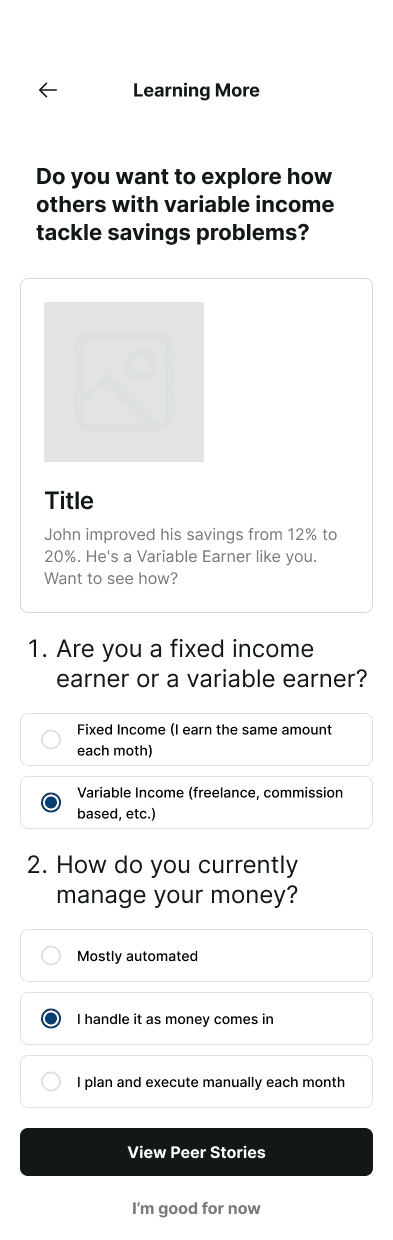
provided that all users want actionable guidance, but not just data, I took it a step further to explore options for that; and arrived at a solution to first get context; next, point out possibilities with maths done; last, let users reflect and make decision.

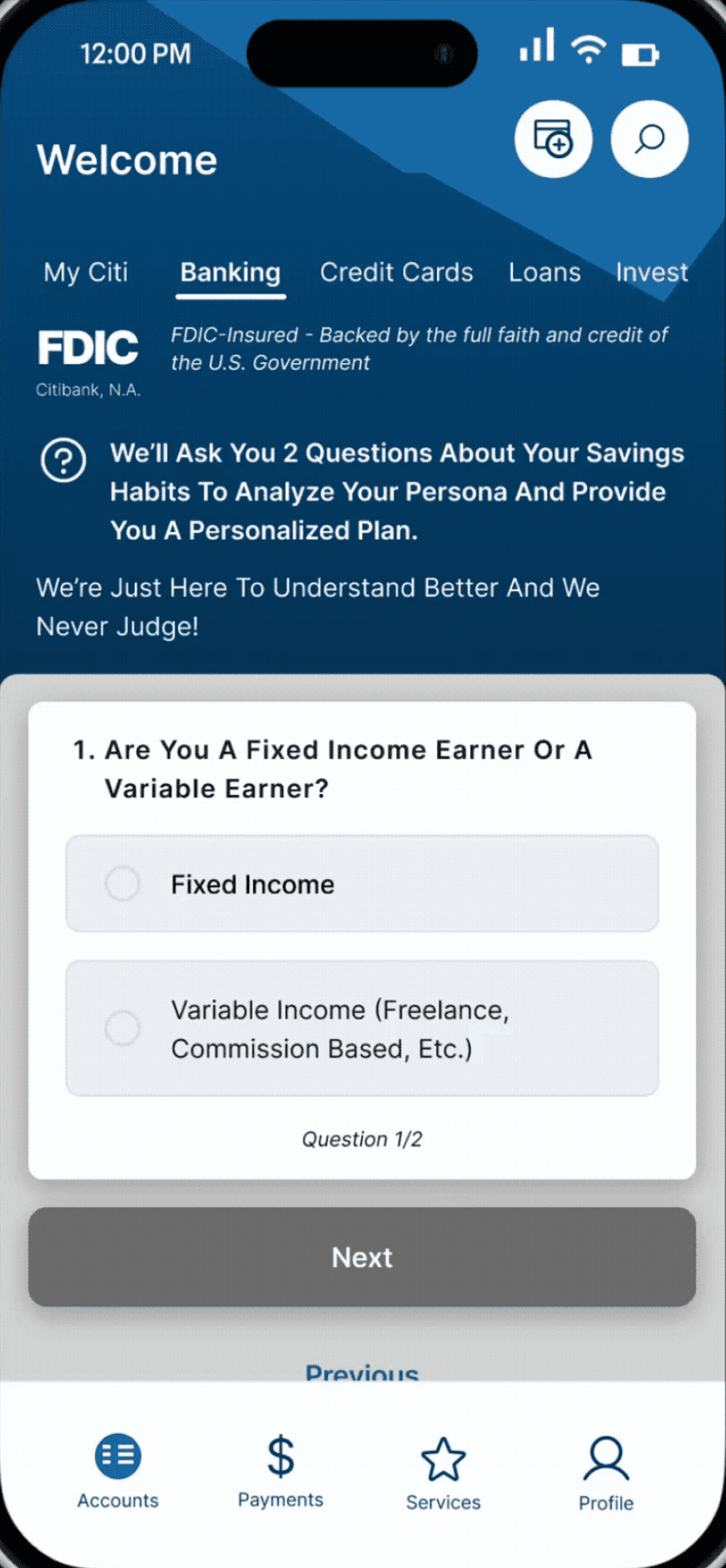
System asks 2 questions about income type and money management to understand user behavior.

2 Questions in Finding Persona

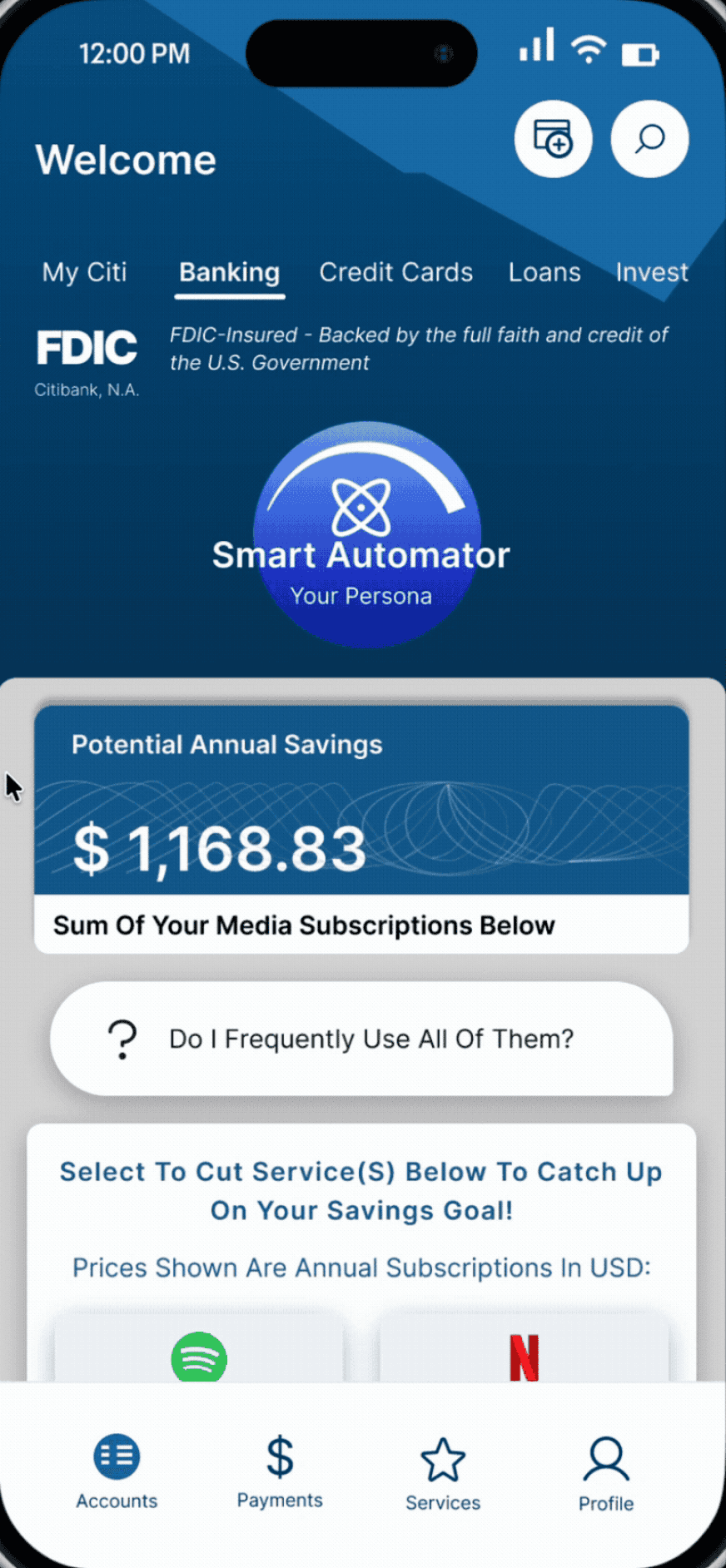
Reflection + Target Savings

Provides a moment for reflection before presenting the math.

do I frequently use all of them?

do I frequently use all of them?

Targeted Savings:

Shows potential annual savings and lists specific, actionable cuts, moving beyond just showing data.

Persona-Driven Context

System asks 2 questions about income type and money management to understand user behavior.

2 Questions in Finding Persona

2 Questions in Finding Persona

Reflection + Target Savings

Reflection + Target Savings

Provides a moment for reflection before presenting the math.

do I frequently use all of them?

do I frequently use all of them?

Targeted Savings:

Shows potential annual savings and lists specific, actionable cuts, moving beyond just showing data.

Other Things Explored

👣

In-Line Peer Stories & Validation of Design Tension

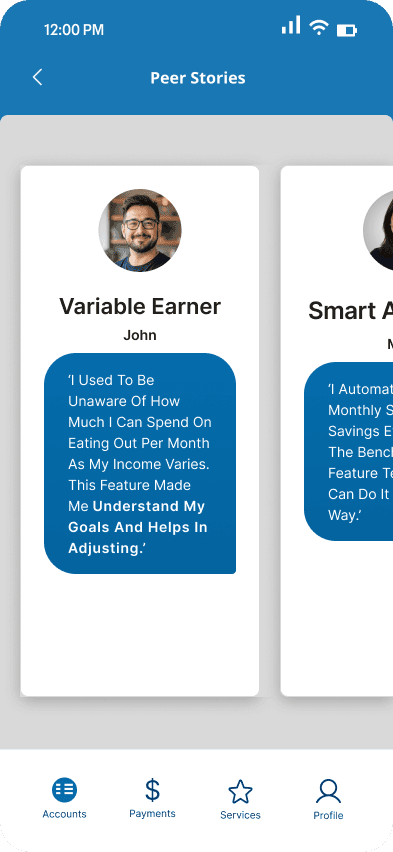
to encourage users to be financially healthy, i thought of bringing in social aspects so people can look at how peers are doing. a lot of problems arose when started, and there were split opinion in whether this function should exist. Supporters found it motivating, opposers found it undermines privacy/ distracting. the function evolved as follows:

Introduced In-Line View Peer Stories CTA

to provide Social Proof + Actionable Insights

Changed to Modal Peer Stories to be less intrusive

Kept Elaboration of Financial Specifics

The placement switched from in-line to a less intrusive modal trigger, respecting user control.

I think it is a good marketing moment

Round 1

Participants

Round 2

Participants

It undermines credibility

It undermines credibility

However, the financial detail was still too high, even for the Supporters.

Introduced In-Line View Peer Stories CTA

to provide Social Proof + Actionable Insights

Changed to Modal Peer Stories to be less intrusive

Kept Elaboration of Financial Specifics

The placement switched from in-line to a less intrusive modal trigger, respecting user control.

I think it is a good marketing moment

Round 1

Participants

It undermines credibility

Round 2

Participants

However, the financial detail was still too high, even for the Supporters.

Other Things Explored

👣

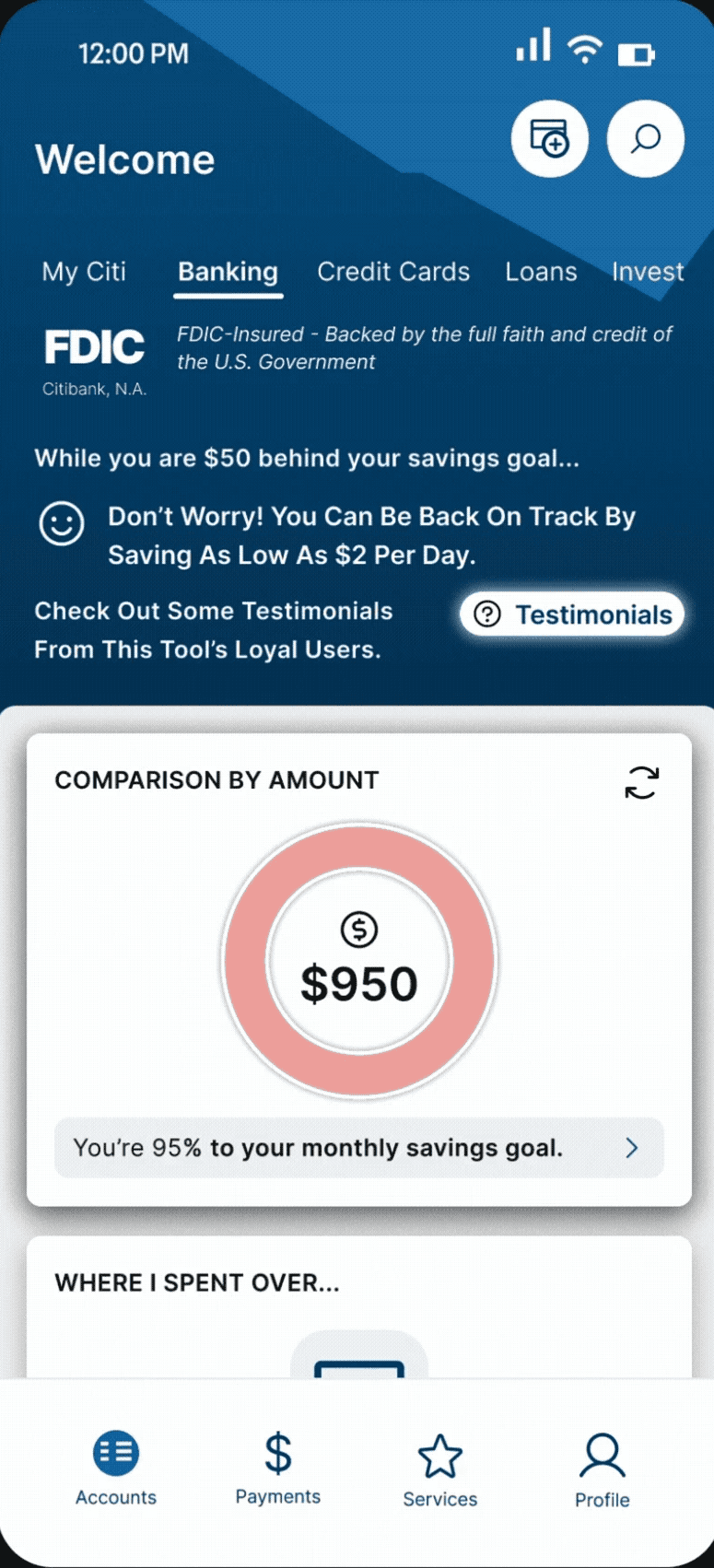
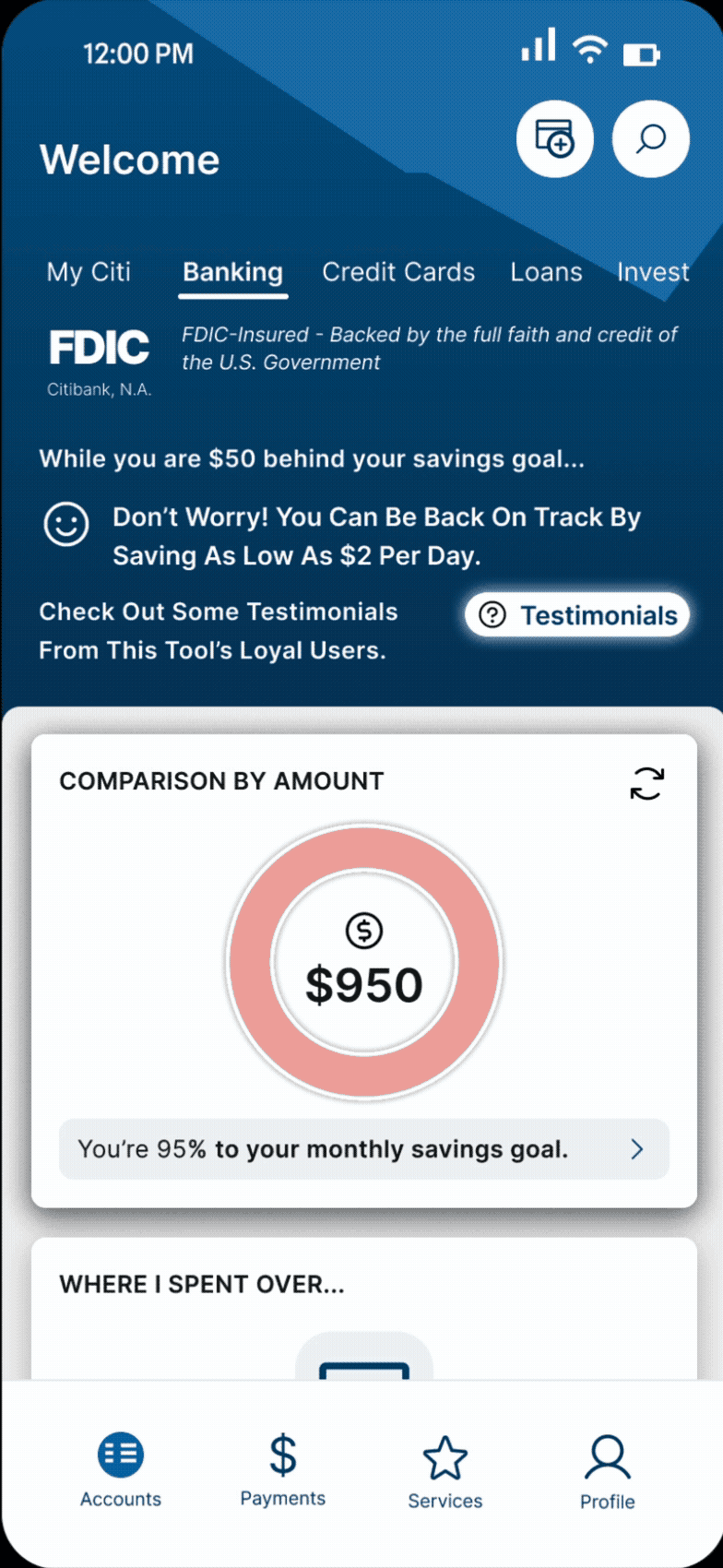
Final Pivot: From Peer Stories to Generalized Testimonials

instead of Detailed stories of how individual users improve, I simplified it into generalized testimonial section, so it promotes the feature yet do not reveal sensitive, emotional finances of users.

Modal Trigger

instead of Detailed stories of how individual users improve, I simplified it into generalized testimonial section, so it promotes the feature yet do not reveal sensitive, emotional finances of users.
Learning

Learning: Financial privacy trumps social proof in banking contexts

Detail Generalization

instead of Detailed stories of how individual users improve, I simplified it into generalized testimonial section, so it promotes the feature yet do not reveal sensitive, emotional finances of users.

Learning

Learning: Financial privacy trumps social proof in banking contexts

Modal Trigger

Detail Generalization

instead of Detailed stories of how individual users improve, I simplified it into generalized testimonial section, so it promotes the feature yet do not reveal sensitive, emotional finances of users.

Learning

Learning: Financial privacy trumps social proof in banking contexts

instead of Detailed stories of how individual users improve, I simplified it into generalized testimonial section, so it promotes the feature yet do not reveal sensitive, emotional finances of users.

Learning

Learning: Financial privacy trumps social proof in banking contexts

Modal Trigger

Detail Generalization

instead of Detailed stories of how individual users improve, I simplified it into generalized testimonial section, so it promotes the feature yet do not reveal sensitive, emotional finances of users.

Learning

Learning: Financial privacy trumps social proof in banking contexts

instead of Detailed stories of how individual users improve, I simplified it into generalized testimonial section, so it promotes the feature yet do not reveal sensitive, emotional finances of users.

Learning

Learning: Financial privacy trumps social proof in banking contexts

Learning

Learning: Financial privacy trumps social proof in banking contexts

Key Takeaways

Process Learnings

Designing something to integrate to an existing app is really different from starting from scratch, and also closer to real world projects. and the follows is what i found the most important in this project:

Process Learnings

🏛️

Branding
Consistency

Successful integration requires matching existing UI Design (Citibank design system).

Key Action

Ensure new elements (buttons, fonts) blend into existing UI and does not look like a discrete function.

⚖️

Scope Over
Perfection

Don't be obsessive about technical details, e.g. prototype animations , focus on key features first.

Key Action

Prioritize solving user problems over polishing edge cases.

⚡️

Start Simple,

Polish Later

Balancing time-consuming hi-fidelity prototyping with efficient visual communication is crucial for productivity.

Key Action

Prioritize solving user problems over polishing edge cases.

⏱️️

UX Value Over Tech Complexity

Technical prototyping challenges (variables, CTAs) must not overshadow the core value of the UX design.

Key Action

Prioritize solving user problems over polishing edge cases.

Key Takeaways

Enjoyable Parts

No one taught us about financial literacy growing up, we all avoid talking about money; and that's why I wanted to make some impacts with this project. unexpectedly, there are a lot moe i gained from it, as an emerging UX Designer:

💬

Listen and Design for empathy

UX is about listening, not validating. Be prepared to pivot based on user needs and emotions, not initial hypotheses.

The Insight

e.g. One participant shared her journey to financial independence after college, abandoning comforts, navigating financial ups and downs, and transforming from panic to pride. Design should prioritize user empowerment.

🔍

Challenge Assumptions

High user familiarity with HYSA accounts require deeper digging to uncover the real business gap: The emotional and practical gaps in financial planning.

The Pivot

HYSA onboarding

🔽

Benchmark Guidance

🌍️

Build for Scalability

While this is designed as a plug-and-play framework for FDIC-Insured banks, To scale globally, balance specificity (culturally relevant context) with generalization is required.

Key Action

Study different nations’ banking system, find generalization framework.

Research Insight 1

1

Everyone Uses Different Methods, But No One Knows Their Baseline

I asked users about how they handle their paychecks, 6/6 users use different budgeting tools & have different workflows: apps, spreadsheets, mental math

Automation Levels Vary Widely

📝

Manual

Spreadsheets

Mental Math

⚙️

Semi-Auto

Budgeting Apps

Manual Checks

Automated

‘I just automate stuff’

Level of Automation

Emotional Journey: Financial Planning

📨 Receive

Stress: 70%

🔍 Review

Stress: 85%

📋 Plan

Stress: 40%

💼 Allocate

Stress: 55%

Variations:

Smart Automator: Lower stress at Allocate

Variable Earner: Highest overall stress

Strategic Controller: Stress at Allocate too

Smart Automator

⚙️

Understands finances well

Wants Adjustable Proportions

Variabel Earner

📈

Fluctuating income

Needs flexible monthly adjustments

Strategic

Controller

🕹️

Knows past bills, wants cut options

Needs quick answers, not manual spreadsheets

🔮 Future Iteration

Adjustable Proportions for users with higher level of automation

Notifications for Pause/ Resume automation from time-to-time

Priority: Establish Benchmark

Focus on providing users a clearer picture of ‘Am i Saving Enough’ question first

Provide a unified and simple starting point before advance customizations

Research Insight 2

2

Flexibility > Rigid Rules

I asked whether it is helpful in distributing their paychecks per the 50/30/20 Upon Receving; while all interviewees acknowledged that 50/30/20 is a helpful foundation, however, they all also expressed the desire for flexibility.

Appendix

Empatheize

Persona Cards

The Smart Automator

The Variable Earner

The Strategic Controller

The Smart Automator

The Variable Earner

The Strategic Controller

The Smart Automator

The Variable Earner

The Strategic Controller

View

Figma

~5 min read

Empatheize

User Journey Maps

behavior Patterns of personas during different money handling stages.

View

Figma

~5 min read

Product Designer

who embraced the pathless path.

Available for full-time roles

Get In Touch

ameliaay.work@gmail.com

Product Designer

who embraced the pathless path.

Available for full-time roles

Get In Touch

ameliaay.work@gmail.com

Product Designer

who embraced the pathless path.

Available for full-time roles

Get In Touch

ameliaay.work@gmail.com